Dimensions
CounterPoint stores measurements in inches. No exceptions. The website will display numbers greater than 12 as feet and inches.
- 46.5 inches will be shown as 3 feet 10½ inches
- 444 inches will be shown as 37 feet
Use this calculator to convert feet and/or inches into inches.
Enter the dimensions of the product when in use, not the packaged dimensions.
These Examples Illustrate Why Package Dimensions Are Wrong
Imagine yourself surfing the web as a customer that isn't familiar with these products, and isn't looking at them in person.

- You would expect a library pocket to measure around 3 × 5 inches since it's meant to hold 3×5 cards
-
The short description gives measurements of 3½ × 5 inches (which is about what you'd expect)
- The measurements shouldn't be in the short description, by the way, but that's a problem for another day.
- But the Details tab shows dimensions of L=8, W=4½, and H=¾ inches
Is it 5 inches or 8 inches? There are 3×5 cards and 4×6 cards; maybe these are for the 4×6 cards? Is the description wrong, or are the details wrong? Can it really hold a stack of index cards ¾ inches thick?
Even if we remove the measurements from the short description, you'd be disappointed if you purchased these to hold your stack of 60 4×6 cards.
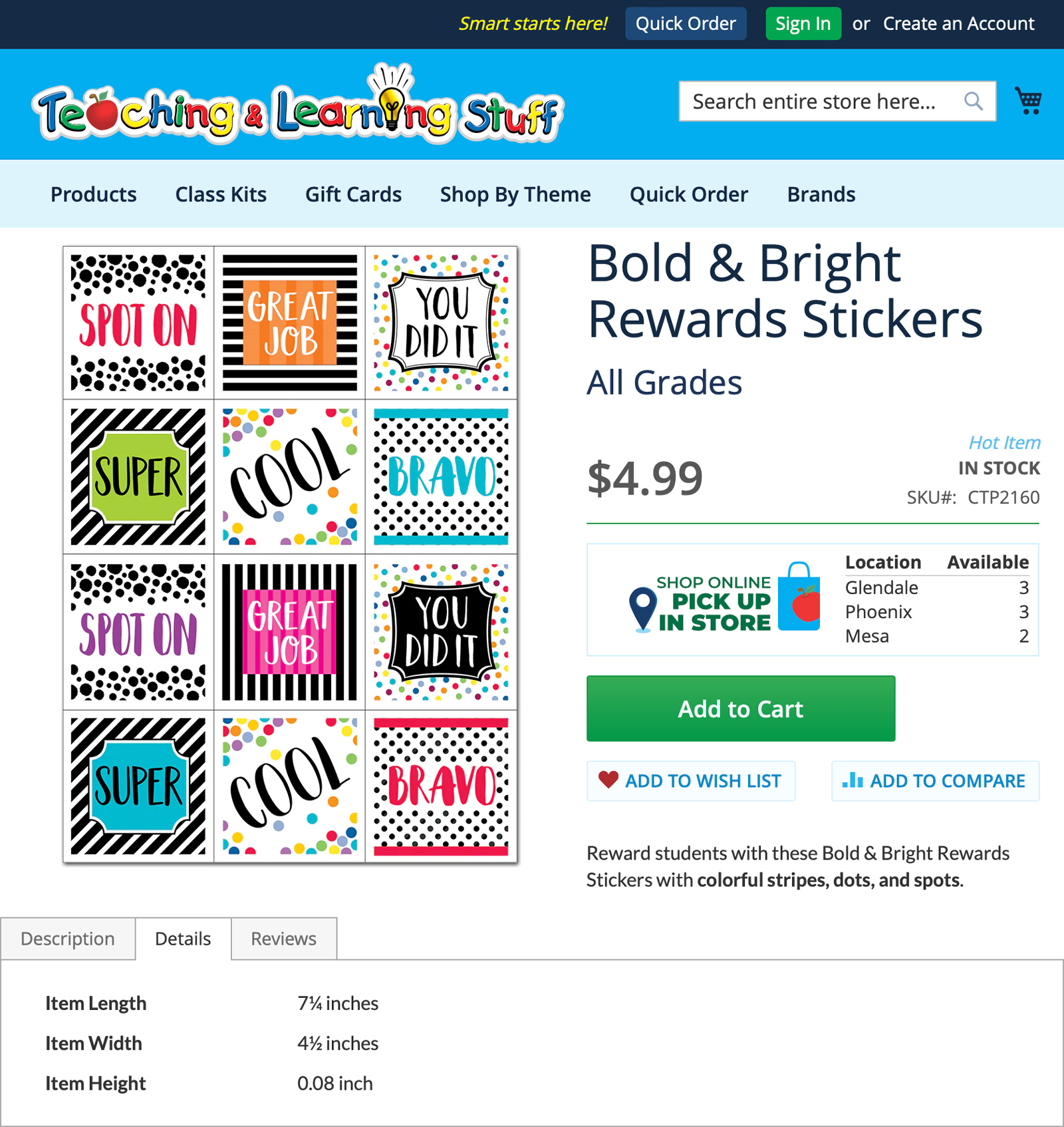
Is each one of those 7¼×4½? That's a really big sticker. Plus they look square in the photo. Or maybe the whole thing is 7¼×4½? Wait, am I going to have to cut these out myself? So none of that makes sense. It must be the whole thing. But, then, what size is each sticker?
"Doing the math" doesn't even help. That's a sticker measuring 1½”×~2”. It doesn't match the squareness shown in the photo — and it's just flat out wrong. (The real answer is that they're each 1” square.)
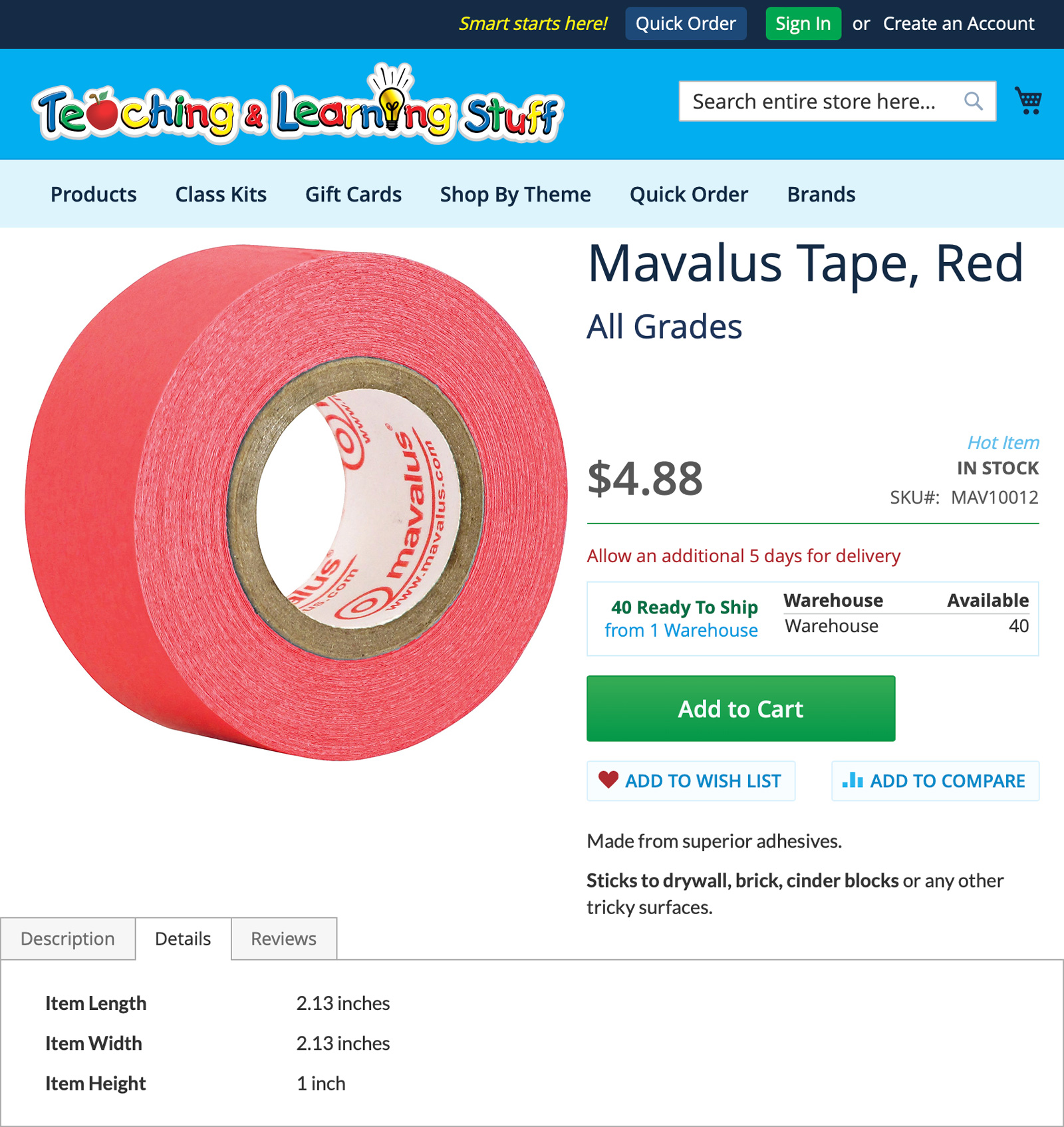
Well the tape must obviously be 1” wide (the height), but I'd really like to know how much tape comes on the roll instead of the roll's diameter.
While these measurements are technically correct — unlike the other examples — they're probably not the measurements the customer would find most useful. It would be better to show width = 1 inch and length = 30 feet.
Showing height = 2.13 inches or leaving the height blank is something of a judgement call. (The customer might be wondering if it will fit in their super-cute princess rose tape dispenser.)
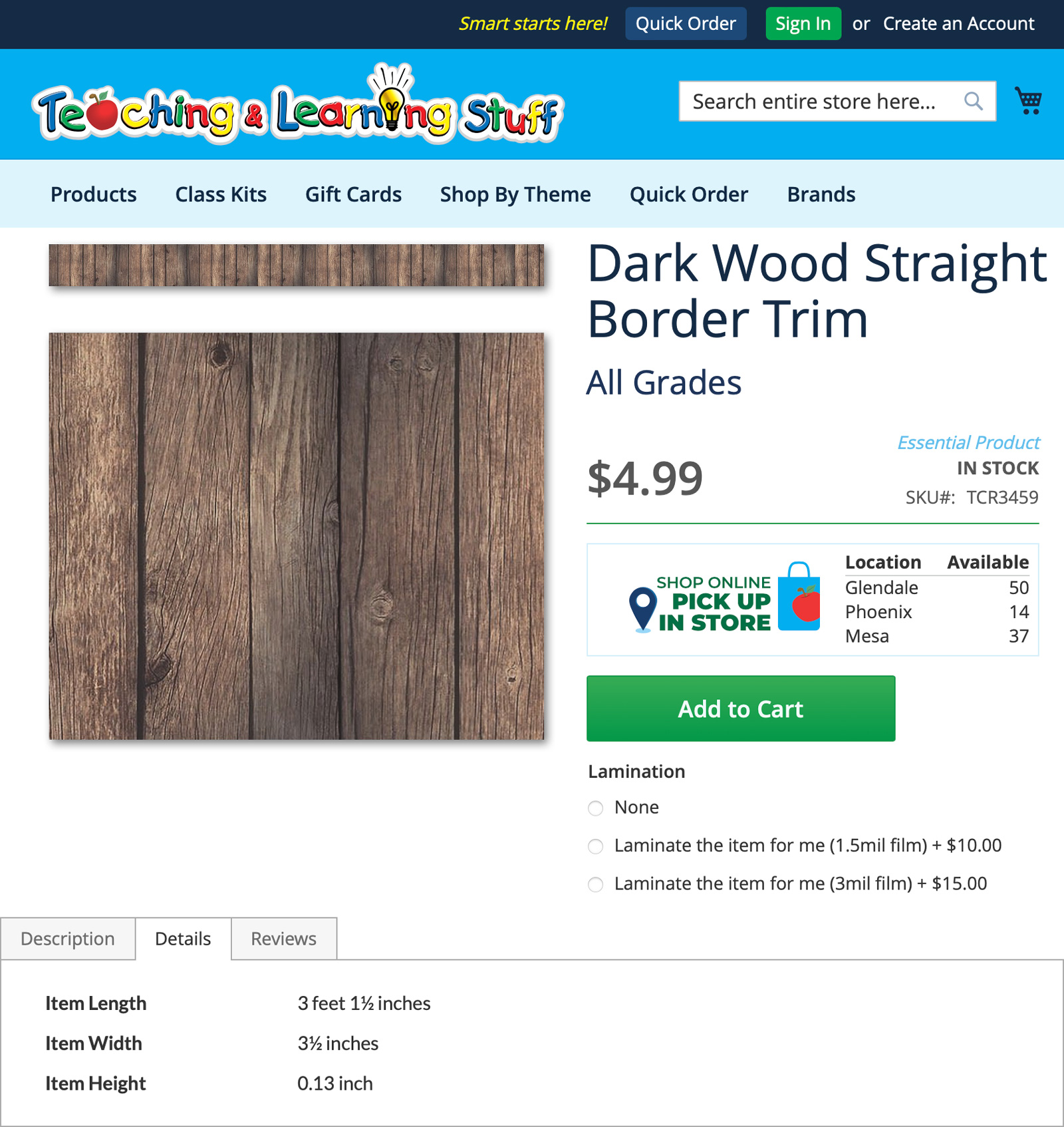
I've measured my space, and the perimeter is 20 feet. Will one pack be enough?
Moral of the Story:
Think of a time you ordered something online, but when it arrived you said, "That's not what I expected."
1-Dimensional Products
When possible, enter all 3 dimensions (ex: Yes, it's called a "12 in. Dinosaur Plush" but it actually has 3 dimensions). Otherwise, enter the dimension that makes the most sense.
- A pointer is 36" long
- An easel is 48" high
- A fraction circle is 6" wide
Enter the other two dimensions as a 0.
Dimensions that are empty or set to 0 don't show up on the website
2-Dimensional Products
There's no single standard for entering dimensions of "flat" products that have only 2 dimensions (such as posters), but these guidelines might help:
- Vertical products that hang on the wall (like posters, cutouts, or pocket charts) are usually measured with width × height
- Paper (like a sheet of writing paper) is also measured with width × height
- Horizontal products on the floor (like carpets) are usually measured with length × width
- The "width" measurement is from left to right when you look at the product in use (there are exceptions, like borders)
- Length or height? Try substituting the word "long" for length: does it sound right?
- A poster is 17" wide × 22" long — that doesn't sound right
- A poster is 17" wide × 22" high — that sounds better
- A border is 3" wide × 36" high — that doesn't sound right
- A border is 3" wide × 36" long — that sounds better
- A carpet is 114" wide × 60" high — that doesn't sound right
- A carpet is 114" wide × 60" long — that sounds better
Books
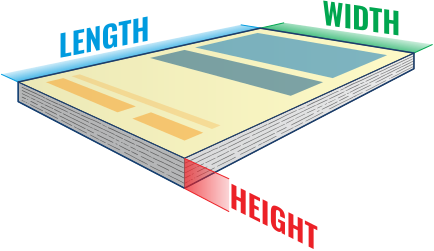
Standards among vendors vary when measuring books. We are following the Amazon guidelines for book dimensions.
- The length is measured from top to bottom when looking at the cover of the book (very often 11 inches)
- The width is measured from left to right when looking at the cover of the book (very often 8.5 inches)
- The height is the thickness of the book (probably something like 0.5 inch)
Borders (Rolled or Not)
-
Length is the total length in inches (ex: 432 inches)
- The website will display 36 feet
- Width is the width of the border (usually around 3 inches)
- Height is left blank (or 0)
Rolls & Tubes
Things that come as a roll are usually measured with width × length.
Height is usually left blank (or 0)*
* If height of the roll when in use is important, then it is the diameter of the roll.
- A roll of butcher paper is 48" wide × 144" length (long)
- A rolled border is 3" wide × 432" length (long)
- A roll of tape is 1" wide × 600" length (long)
Tubes are measured differently. But be careful: we're talking about the product IS A TUBE – not the package it comes in.
- Width & Height are both the diameter of the tube
- Length is the length of the tube
Length? Width? It's a Toss-Up
Sometimes it's not obvious which dimension is width, and which is length.
- Enter the largest value in length
- Enter the smaller value in width
- Height is always measured from the ground up, when in use
Products With no Thickness
Some things — like a name tag, poster, or sticker — have virtually no thickness. Choose one of these options:
- Enter a very small number like .01 inch
-
Enter 0
- Tip: Entering 0 will prevent the product from showing up on the 'missing data' reports
- Leave that dimension blank
Dimensions that are empty or set to 0 don't show up on the website.
Assortments
Some products are packaged with assorted sizes (ex: a pack of cutouts with 2 different sizes).
- Enter the dimensions for the largest size
Some products contain multiple parts of various sizes (ex: a kit).
- Use your best judgement
- Ask yourself "What will be the most useful to the customer?"
- Sometimes providing dimensions of the largest part might not make the most sense
Assembled?
If it's clear what size a product will be once assembled, use those dimensions. However, some products can be assembled to many different sizes (ex: a bulletin board set)
- Include a detailed size breakdown in the product description
-
Use your best judgement:
- Enter the dimensions of the largest piece
- This is a rare case when the package dimensions might make the most sense